
We Wear Respect
Change the scrubs, and the hospital changes
The garment a clinician wears longest in a lifetime — and the one left neglected the longest. Hopper redesigned it from the beginning.

At the end of the day, what the scrubs leave behind
Picture the moment you take off your scrubs after a long day of seeing patients. The shoulders ache, the lower back feels heavy, and the back is damp with sweat. What if part of that fatigue — even the smallest part — came from scrubs that had been tugging almost imperceptibly at your body all day long?
Over a lifetime, a clinician spends tens of thousands of hours inside their scrubs. Raising an arm to examine a patient, bending at the waist to treat, sitting and standing hundreds of times over. With every one of those movements, the scrubs quietly do one thing: they either help the body or hinder it. And yet, strangely, the garment a clinician wears longest is the one that has been neglected the longest — cheap, uniform to the point of indifference, made with no regard for the person inside it.
The garment worn the longest has been neglected the longest.
A question that came from inside the exam room
This question did not come from outside the exam room. It came not from the desk of a designer reading trends, but from the day of a person who wore the garment and faced patients in it. A professional who misses not even the smallest detail of care, forced to endure the discomfort of the one thing they wear every day — that contradiction is where Hopper began.
The market’s answer was always the same: cheaper, more of it, but never better. So Hopper chose the simplest and hardest path at once. If the scrubs the world needs do not exist, make them. The standard applied to caring for a patient — a standard that admits no compromise — would be applied, unchanged, to the scrubs the clinician wears. Devotion to good medicine and a relentless pursuit of good clothing, it turns out, come from the same temperament.
The idea that it is not clothing, but equipment
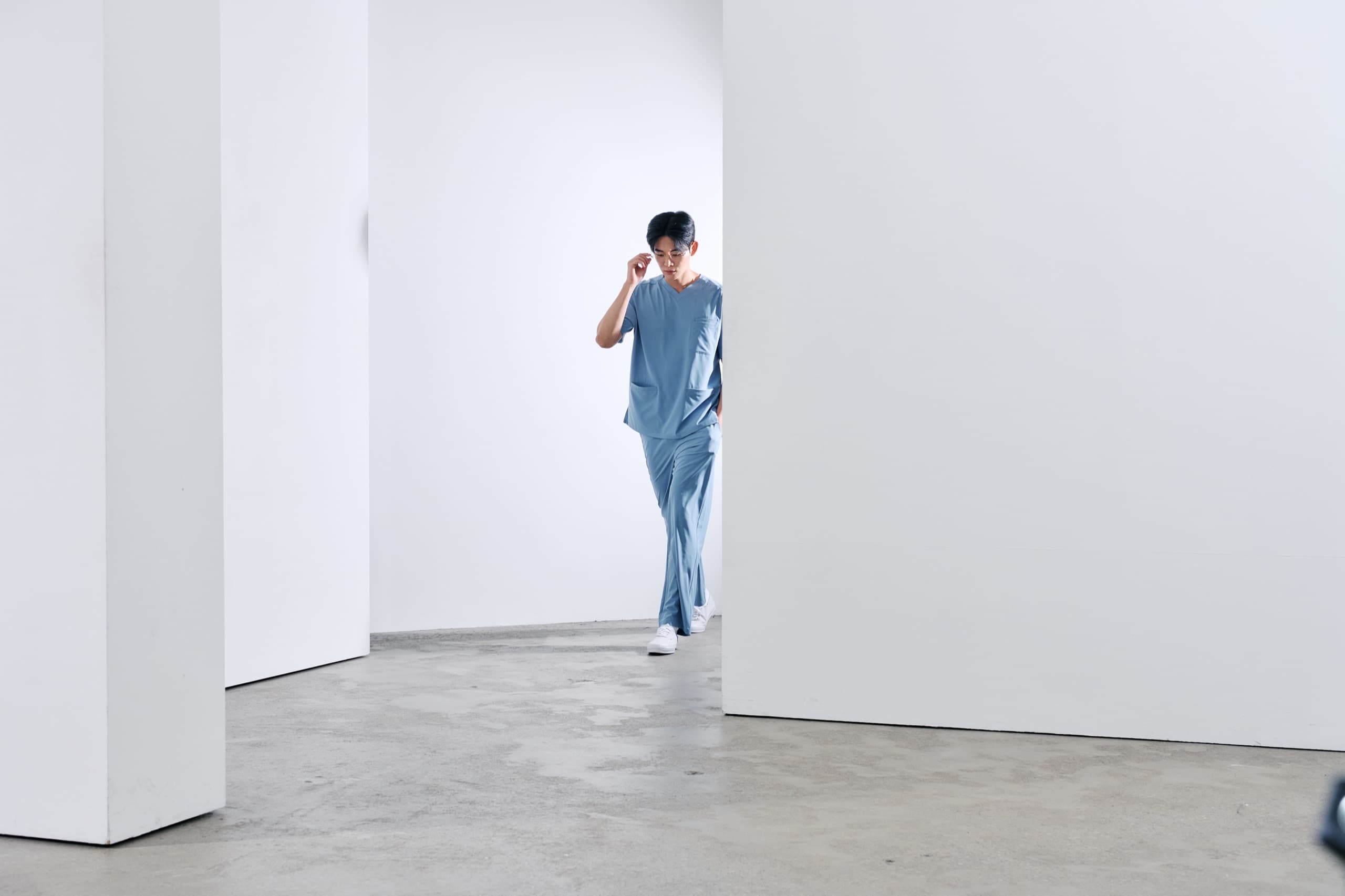
Hopper does not call its scrubs a “uniform.” Scrubs should be judged not by colour or price, but by whether they help or hinder the movement and focus of a clinician. Hopper is a company that began from this point of view — the idea that scrubs are equipment supporting the work of care.
This definition rearranged the order in which scrubs are made. Where most scrubs begin with shape, Hopper began with motion. The rotation of the arm and shoulder, the bend at the waist, the flex of the knee. We first analysed the joint movements most frequent in the clinical setting, then worked backward to engineer a structure that would not obstruct them. Fabric and design followed, each optimised to the movement it had to serve.
That research left its mark throughout the garment. The diamond gusset beneath the underarm keeps the fabric from riding up when the arm is raised high; the triangular pleat at the chest keeps you covered even when you bend deep; the three-dimensional pattern preserves the silhouette through endless sitting and standing. These details are not ornament but function — the kind only someone who has passed through the clinical floor with their own body could think of. In the end, this design was proven by a product patent for high-performance scrubs.
What Hopper makes is not clothing, but the very movement of the clinician.
Only when you forget you are wearing it
The paradox of good equipment is that it makes you forget it is there. The best scrubs are not the ones you see, but the ones you never feel. When the shoulders are unaware of the fabric and the waist feels no pull — only then can a clinician give the last patient the same focus given to the first.
This is why Hopper is so devoted to high-performance fabrics. The ultralight fabric supplied to Hopper alone in the entire world is light enough to make you forget you have it on, and the recycled yarn from Japan’s Teijin — chosen by global brands — means caring for the environment and wearing good clothing are no longer a choice between one or the other. The fit of the white coat was refined over patterns from the global fashion school ESMOD. A person obsessed with the details of care could not stay indifferent to the details of what they themselves wear.
The best scrubs are the ones you never feel.
To wear pride
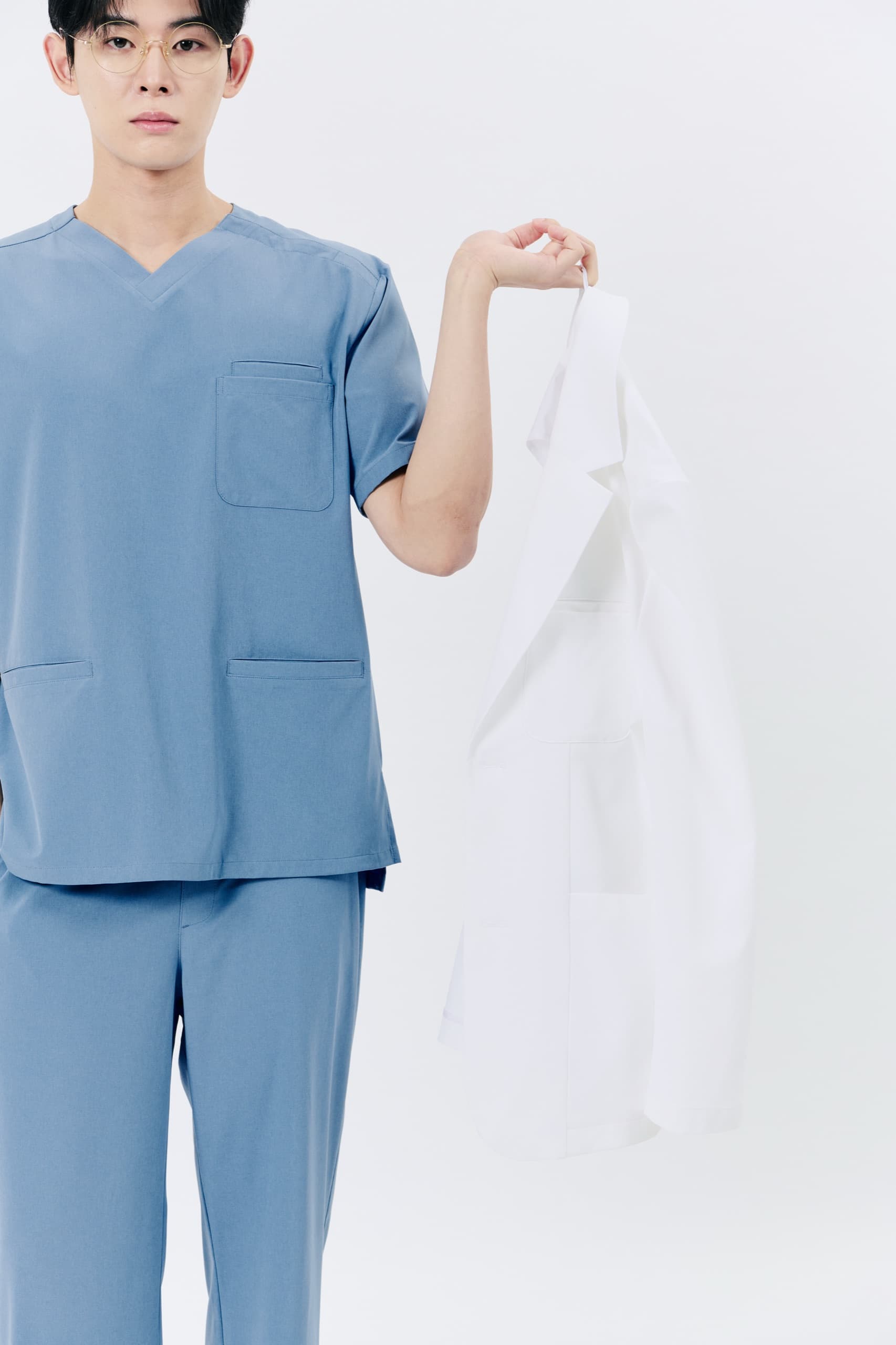
The moment a white coat goes on, the patient sees a professional. Behind that coat lie decades of study, countless nights, and unbroken devotion. The scrubs are the symbol of all that time. Then shouldn’t that symbol be as exacting as the standard you hold yourself to?
Hopper’s slogan is “We Wear Respect.” It is a declaration to redefine scrubs in the language of respect — so that the expertise held within is never at odds with the figure seen from without; so that the you inside and the you outside are one and the same. In the end, Hopper is a brand about the way a clinician wears their own self.
So that the you inside and the you outside are one and the same.
The definition of equipment reaches further
Seeing scrubs as equipment widens the scope of responsibility. Hopper leaves out the fluorine-based water repellents that accumulate in the body, and designs at the knit stage to shed fewer micro-particles in the wash. Sustainability is not a slogan but something inscribed into the manufacturing itself.
And Hopper carries this value beyond the company as well. We support medical mission work abroad with scrubs, and keep the promise of “clothing for people” to those who wear it and those who make it alike. Making good clothing and doing the right thing are, to Hopper, one and the same.
Again, the moment of putting it on
Good scrubs make the wearer more composed, more free, and focused for longer. So that the you inside and the you outside are one and the same. What Hopper sets out to prove every day comes down, in the end, to one thing.
Change the scrubs, and the hospital changes.
Four pillars
Quality
Exclusive and recycled premium fabrics, joined with sportswear-grade construction. The highest standard for the garment worn longest.
Comfort
Designed from motion rather than silhouette, so a shift past twelve hours never pulls at the body.
Design
A professional silhouette that also carries the hospital’s brand — keeping the outside consistent with the expertise inside.
Responsibility
Built on fluorine-free, low-particle materials, and shared through workwear we supply to medical missions abroad.
History
- 2022.03FoundedBegan with wear-testing on 250 medical professionals
- 2023HOPPER brand launchFirst MVP released
- 2024Teijin ECOPET® exclusive supply agreementBrought Teijin recycled yarn into Korean medical workwear
- 2025Corporate R&D center established
- 2025Group fitting scaled up · Hopper smart system builtGroup fittings: SNU Bundang 100 · Severance 450 · Kyungbok 250
- 2026SUPER Scrub MVP released
- 2026Product patent grantedThree-dimensional patterning that follows clinical movement
Certifications and patents
Intellectual property
Registered patent
Medical workwear integrating movement-driven 3D patterning with high-durability functional fabric
Pending patent
Spandex-free, fluorine-free (C-ZERO) water-repellent circular-knit medical fabric — dual filing for method and textile
Design registration
Active Diamond Cut — a set of medical garments
Trademark registration
hopper (wordmark / logo)
ISO certifications
- ISO 9001Quality management
- ISO 13485Medical device standard
- ISO 14001Environmental management
- ISO 45001Occupational health & safety
- ISO 27001Information security
- ISO 37001Anti-bribery management
Recognition and awards
- Certified venture company
- Excellent employee-invention compensation company
- Selected for the women-owned business global accelerator
- Export package support program company
KATRI accredited test results
- Formaldehyde not detected
- Aromatic amines (carcinogenic azo dyes) — all items safe
- Excellent abrasion and pilling fastness
See where this thinking leads
BusinessIf there is something to build together, tell us any time.
Start a conversation